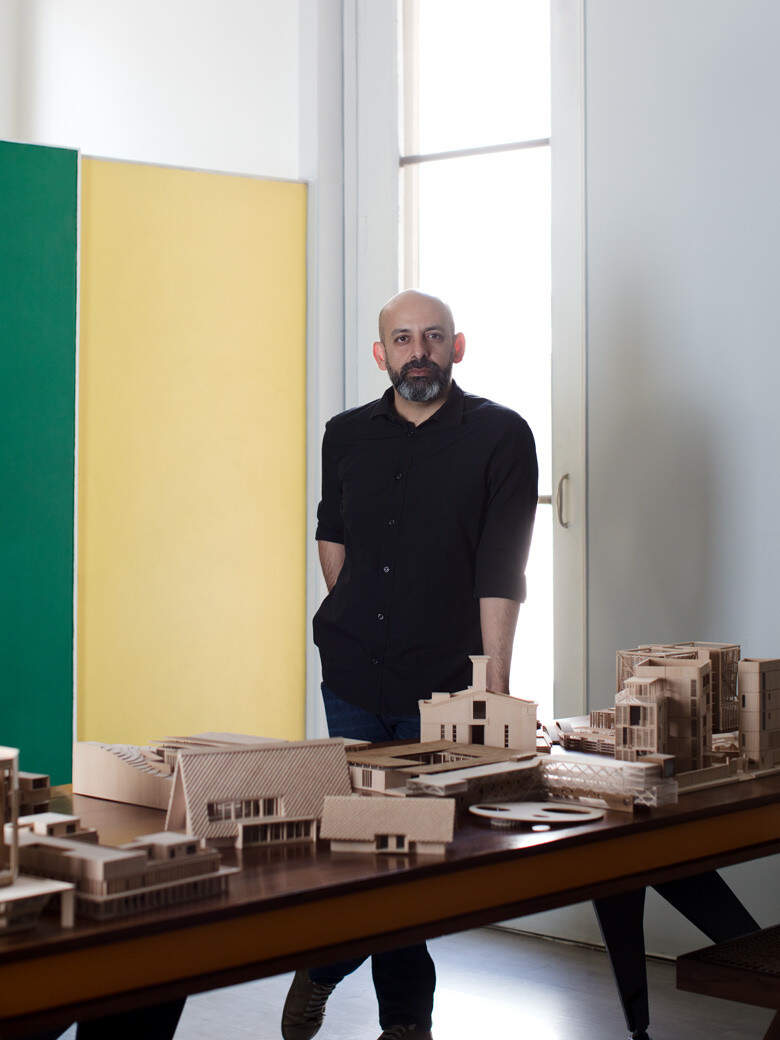


MARTAND KHOSLA
In the year 2020, activities in physical spaces were greatly curtailed, socializing made taboo, and human contact resoundingly virtual. This presented both challenges and opportunities to the world of art, where associating amid paintings and sculptures is one of the primary endeavours. The art world had been investigating this virtual territory increasingly in the past decade, with gallery and museum websites, online exhibitions, PDF pitches, and Instagram initiatives becoming a lingua franca of the cultural zeitgeist. So with a pandemic-induced lockdown, the world of art has pulled out all the guns in the attempt to keep the wheels in motion. Nature Morte has participated in this virtual jamboree of the last few months but it has also led us to posit the options available when it would not be linked to business and commerce. We invited artist and architect Martand Khosla to create a platform where he could collaborate with artists to create new types of spaces to display their artworks, untethered to reality, rationality, or rebuke. The results, we surmise, will be varied and curious, hopefully, jolting and incredulous as well. (Peter Nagy, 2020)
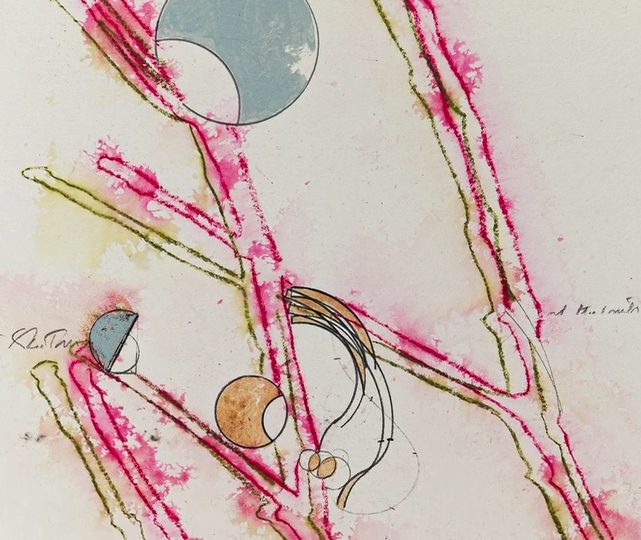
Jitish has been exploring the passage of time and the movement of shadows through his daily rituals and recent works in the Circadian series. In our conversations, interesting parallels emerged between his approach and my own exploration of imagined and virtual spaces.
The path the sun alludes to circular motions as determinants of the circadian rhythm, while architecture of the virtual space took me to rectilinear grids within Euclidean geometric constructions. In some ways Jitish is trying to capture the ephemeral by recording transient natural phenomenon. The architectural sketch, or the thought of a building is as difficult to capture as the moving shadow, as it changes frequently on its way to becoming a definite volume – so the sketches try to capture the ephemeral on its way to becoming something that will exist.
Herein emerged the idea of a series of pavilions, one for each drawing from the series set along a circular path – but overlaid on a rigid linear.
- Martand Khosla
ABOUT MARTAND KHOSLA
Martand Khosla lives and works in New Delhi, India. His art practice explores urban continuity and transformation, as both complement and counter to his experience building in contemporary India. Having founded and run an award-winning architecture studio for over twenty years (RKDS). Martand initially pursued art to explore how construction-fueled employment shapes identities and nostalgia. Situated as both participant and observer, he employed tools of the State, such as the ubiquitous rubber stamp, to render its imprint on lives within traditional definitions of power and dispossession. Brick dust collected from his construction sites became a language of tension, allowing material to pay tribute to both the temporary and permanent, to construction and demolition.
An architect’s natural preoccupation with space inevitably emerges in his work, not as a challenge to ‘build’ – but rather to foreground an object’s intrinsic potentiality. His works traverse the lines between sculpture and object, movement and remnant, material and memory. Inspired by his studies of repetition and the human churning of industrialization, he replicates the micro-processes of macro-construction. And simultaneously, he moves from the lens of authoritarian power to its dispersion, exploring the transformations that lay in between.